Literacy Program in Benin Integral to THP Success

Report by Pascal Djohossou, Country Director of The Hunger Project

Literacy: a valuable tool in THP’s partnership with epicenter population

Literacy holds a very important place in THP-Benin: it influences every stage of the partnership with the population and acts as a powerful tool to strengthen self-development by the villagers and to facilitate the expansion of THP-Benin village animator’s actions. Literacy also contributes to changes in gender relations and women’s leadership, as well as facilitating communications between village partners and the THP-Benin office.  For these reasons, the training of literacy trainers is a priority aspect of THP-Benin's programs.

In Benin, literacy classes are taught in seven different local dialects.  Starting in 1998, THP-Benin began to provide literacy training and produced and printed teaching materials in the local Aizo language.  This had never been done before by any organization or by the government.  THP also began a monthly newspaper written in Aizo, which is still being published.


At Adohoun, 56 trainers in literacy completed their training and are ready to train others.

In addition to the fact that literacy training prepares for self-development, THP-Benin identifies, in consultation with village development groups, those literate villagers who could act as animators.


Students from Athieme village hear results of their first series of literacy classes.

The main criteria for the selection of animators are the following:

As soon as the prospective animators have been nominated, they are trained by THP in village project animation and monitoring techniques. They are also, more importantly, taught how to acquire ownership of and disseminate the philosophy and types of actions of THP-Benin with a view to gradually expanding the partners’ group and therefore the areas covered.

Women’s leadership

After acquiring literacy skills, women become effectively involved in the operations of the epicentre coordination committees and actively participate in the decision-making process.


This student from Athieme village was given a "prize of encouragement" for her progress in becoming literate..

The women are increasingly taking an active role in the literacy training program as teachers. This is a trend which the Hunger Project-Benin is monitoring and supporting.

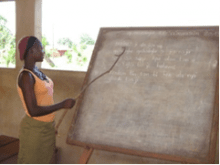
Some of the women show extraordinary determination, as did Emilienne Hounkanrin, a woman from the village of Atchannou (Kpinnou Epicentre) who, when literacy training was initiated in the area, walked a distance of four kilometres from her village to teach a literacy class.


Emilienne Hounkanrin, who walks long distances to teach literacy classes.

Images from Training of Trainers Programs in Four Areas


Two literacy trainers at Ekpé receive teaching materials from Anges Gbaguidi of THP-Benin.


Atchannou training of trainers program graduation photo.


Adohoun village chief addresses the new literacy trainers.


Boxes of chalk and a teaching guide are given to the literacy trainers for use with their classes.


Literacy trainers from Dedekpoe at a Training of Trainers.


Evaluation of the Wawata literacy trainers.

Statistical data on literacy training at THP-Benin

PROGRESS IN LITERACY IN THE 68 VILLAGES CONCERNED


Epicentres

Year

Number of villages

Instructors trained

Literacy graduates

REMARKS

Women

Men

Total

Women

Men

Total

WAWATA

1999 à 2001

15

8

38

46

1047

1807

2584

Advanced level (post-literacy)

KPINNOU

2000

7

8

8

16

148

207

355

Advanced level (post-literacy)

2001

39

17

85

102

1267

1191

2458

of which 377 at advanced level (post-literacy)

EKPE

2001

6

8

2

10

156

54

210

Advanced level (post-literacy)

AYI-GUINNOU

2001

1

1

0

1

38

2

40

1st level

TOTALS

68

42

133

175

2656

3261

5917


OVERVIEW OF LITERACY ACTIVITIES IN THE 68 VILLAGES CONCERNED (all levels) AS OF 31/12/01

Epicentres

Total number of villages receiving literacy training

Total number of instructors trained

Total number of literacy programme graduates

Women

Men

Total

Women

Men

Total

Wawata

15

8

38

46

1 047

1 807

2 854

Kpinnou

46

25

93

118

1 415

1 398

2 813

Ekpè

6

8

2

10

156

54

210

Ayi-Guinnou

1

1

0

1

38

2

40

TOTAL

68

42

133

175

2 656

3 261

5 917

Implementation process

Literacy is granted very high priority in the general action plan adopted by THP-Benin for the partners.

It comes immediately after:

Literacy training activities begin with the creation of development groups of like-minded people interested in implementing common projects. These groups select amongst themselves a group member who can make himself/herself available and who is willing to attend a "training the trainers" course and to bring back to the other group members the knowledge acquired during such training.

Therefore, there are as many literacy classes as there are development groups. For considerations pertaining to the quality of teaching, the size of each class is a maximum of 30 students.

The literacy program is structured in two skill levels: the initial literacy training phase (learning how to read and write) extending over 6 months and the post-literacy phase (intensive practice of the language) extending over one year.

Future Outlook

Literacy activities have a tangible, undeniable impact on the implementation of THP-Benin action plan in collaboration with the partner populations. However, the post-literacy phase, which is a pre-requisite to sustain the impact, demands substantial inputs and requires follow-on activities for at least one year.

THP-Benin cannot by itself conduct post-literacy training activities as they should be conducted and simultaneously continue to open new classes in other areas. Therefore, THP-Benin intends to forge partnerships with others institutions to synergize its work with like-minded organizations.

Contacts have been made with the Directorate of Literacy and Adult Education (a state entity under the Ministry of Culture and Crafts) and with the Unit to support Literacy Activities (an entity funded by the Swiss Cooperation Agency). In all likelihood, a truly operational partnership with these two entities may be expected as of the first quarter 2002.